
The alarm rings at 5:45am and the meeting is at 8am. Children get up at 06:30. In the small window you need to fit in a workout that keeps you healthy, strong and balanced.
I’ve been there a gazillion times. No-Fail Full Body Workouts for Busy Mornings There were some mornings I did it. Most mornings I would snoop fume and say to myself, “I’ll work out after work.” Most mornings I would hit the snooze and say, “I’ll go to the gym after work.” By six pm, I didn’t want to be in the gym.
Motivation was never the issue. The issue was the plan. I was attempting to do a 60-minute gym session in a time that didn’t have 60 minutes to spare. After I started to do short full body exercises in my living room before anyone else woke up, everything changed.
This is my system. Three routines. No gym. No commute. You select the one that is most appropriate for your morning and you are done.
Why Short Morning Workouts Produce Real Results
According to a 2023 study published in British Journal of Sports Medicine, people who exercised vigorously for less than 15 minutes daily had a reduced risk of all-cause mortality. No hour required. You need consistency.
There are a few reasons why morning training can be effective. Cortisol levels are highest 30-45 minutes after waking. The hormone surge allows the body to release fat for energy. Neuroscientist at Stanford, Andrew Huberman, has been talking about the importance of morning exercise and light exposure to stabilize the circadian rhythm to benefit sleep quality the next night.
EPOC (Excess Post-Exercise Oxygen Consumption) is an effect that is triggered at the end of short full body sessions. Your metabolism remains high for hours after your workout. You burn extra calories while you sit at your desk, commute to work or chase your kids around the house.
The behavioral aspect is important. In his Tiny Habits model, Stanford behavioral scientist BJ Fogg uses the premise that small behavior in a consistent context becomes automatic behavior. 6am workout in kitchen for 10 minutes is a tiny habit. Spending an hour exercising in a car ride isn’t.
James Clear’s Atomic Habits is a book on habit stacking. No-Fail Full Body Workouts for Busy Mornings After [current habit] I will [new habit]. Once I finish my morning coffee I will do 10 minutes of squats and pushups. That anchor will make the behavior stick.
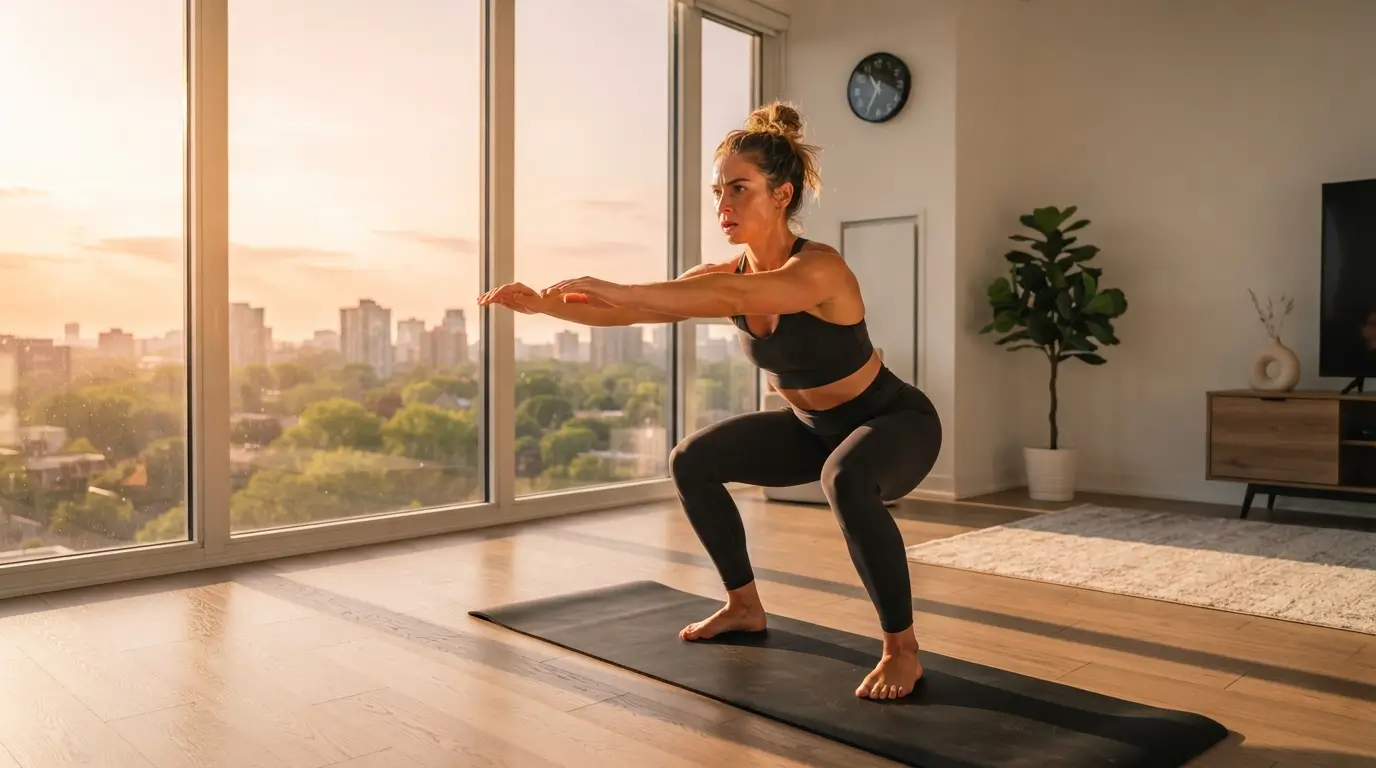
The 2-Minute Warm-Up You Cannot Skip
Your body temperature decreases in the night. Your joints stiffen. No-Fail Full Body Workouts for Busy Mornings Your muscles are cold and stiff. Don’t do a lot of burpees at 6 AM and end up with a strained hip flexor.
Repeat before each session. It takes 120 seconds.
- Take turns to do the march in place with high knees for 30 seconds.
- Do Arm Circles forwards and backwards for 20 seconds.
- Slow body weight squats for 20 seconds.
- Each set of torso twists is 20 seconds long.
- Circle hips forwards and backwards 15 times.
Your joints are lubricated with synovial fluid. Your heart rate increases. Your nervous system is activated.
However, there’s one caveat: If you didn’t get at least 5 hours of sleep, avoid exercising and sleep more. Fatigue decreases coordination and increases the risk of injury. No-Fail Full Body Workouts for Busy Mornings The exercise will be sent tomorrow.
The 10-Minute No-Equipment Routine
It’s my go-to routine. Requires no equipment and only requires space as large as a yoga mat. I have done it in hotel rooms, airport lounges and at 5:30am in the dark in my kitchen.
Set a timer. Do each exercise for 45 seconds. Rest 15 seconds. Move to the next.
- Jumping jacks
- Bodyweight squats
- Pushups (knees and/or toes)
- Reverse lunge – backward leg crossovers
- Plank hold
- Step-back burpees (if it is okay, step-back burpees are okay too)
- Mountain climbers
- Glute bridges
- Superman holds
- Squat jumps
This targets your core, glutes, hamstrings, quadriceps, triceps, back, shoulders and chest. This is a complete body workout, in true form.
Also Read: Strength Training Tips for First-Time Beginners 2026
According to the ACE Fitness estimates, a 150 pound person will use 80 to 130 calories in 10 minutes at moderate intensity. It’s not a large number. No-Fail Full Body Workouts for Busy Mornings So the combined effect after weeks and months is.

The 20-Minute Dumbbell Version
This workout provides actual resistance and therefore, muscle building if you have a set of dumbbells. At home I have the Bow flex Select Tech 552s. No-Fail Full Body Workouts for Busy Mornings These range in price from $300 to $400 a pair and instead of 15 sets of fixed dumbbells. PowerBlock offers a similar product at the $250 to $350 price point.
Do a Superset. Perform exercises using Superset method. Do Exercise A and Exercise B back to back. Rest 45 seconds. Repeat for 3 rounds.
Superset 1:
- A: Goblet squats, 10 reps
- B: Bent over row, 10 repetitions each arm
Superset 2:
- A: 12 reps of Floor press
- B: Romanian deadlift, 10 reps
Superset 3:
- A: Bench Press, 10 reps
- B: Reverse lunges 8 per leg
Finisher: Farmer Carry for 60 seconds and plank for 60 seconds.
This system provides you with push/pull, lower body and core training in 20 minutes. No-Fail Full Body Workouts for Busy Mornings Exercise scientists at CUNY Lehman College, Brad Schoenfeld, have found that full body programs are just as effective as split-body programs as long as the volume is kept the same per week. A bro split is not necessary to build muscle.
The 30-Minute Full Session
When the event schedule is open this is the whole experience.
Warm up: 3 minutes of inchworms, leg swings and arm circles.
Strength circuit (20 mins, 4 rounds, 60s rest between rounds):
- Squats, 12 reps
- Push-up variation, 10 reps
- Single Leg Romanian Deadlift, 8 reps each leg
- Renegade Rows, 8 per arm
- Lateral lunges (10 on each side)
Cardio & core finisher (5 minutes):
- 40/20 high knees
- 40 bicycle crunches then 20 rest.
- Burpees, 40 on, 20 off
- Dead bugs, 40 on, 20 off
- Sprint in place: 40 on, 20 off.
Cool Down: 2 minutes of forward folds, quad stretches and deep breathing.
How to Scale These Workouts
It’s not a time that is the same everyday. Fitness levels vary from person to person.
Beginner: Perform push ups on your knees. No-Fail Full Body Workouts for Busy Mornings Substitute step-backs for burpees. Take a 30 second rest between exercises. Cut the rounds to 2. Focus on form. At this point, speed is not important.
Intermediate: Standard exercises. 15 to 20 seconds rest. Incorporate some weights whenever possible. Add 1 plyometric per session.
Advanced: EMOM – Every Minute on the Minute. No-Fail Full Body Workouts for Busy Mornings Practice pistol squats, archer push-ups and jump lunges. Reduce rest time to less than 15 seconds. Use weight vest or heavier dumbbells.
Progressive overload is a principle that’s applied at all levels. Increase reps, slow reps and/or increase resistance as needed per week. Spreadsheets are not required.
Fasted or Fed: What to Eat Before You Train
It is a common question that is asked in any fitness forum online. My practical point:
If training is less than 20 minutes in duration, train fasted at moderate intensity. No-Fail Full Body Workouts for Busy Mornings Drink a glass of water when waking up. Skip the food. A short session should be able to be powered by your stored glycogen.
If you are doing a high intensity or strength session of more than 20 minutes, consume some smaller food 15–30 minutes before exercising. A banana. One tablespoon of peanut butter. Two or three dates. A thing that can be eaten in minutes that will not accumulate in the stomach when burpeeing.
Follow the workout with a meal containing 20-40g of protein and a little carbohydrate in the first hour after exercise. Eggs and toast. Greek yogurt and fruit. No-Fail Full Body Workouts for Busy Mornings Oatmeal and protein shake. This helps to build muscle protein and restores glycogen levels.
An important reminder for those with diabetes or blood sugar control problems: fasted high intensity training may lead to low blood sugar. No-Fail Full Body Workouts for Busy Mornings Please consult your physician before forgoing breakfast on training days.
The Real Reason People Quit by Week Three
I have taken part in tens of fitness plans. I have tried most of them and have stopped. The same pattern will repeat each time. The first week is an exciting one. Week two is fine. It’s week three that makes the bell go off, and my brain says, “you’re tired, you don’t need it, get on Monday.”
The answer is not more willpower. Just it’s better design.
As BJ Fogg points out, motivation doesn’t last. It fluctuates. The key is to make the behaviour as small and easy as possible. Squat and pushups count for 5 minutes. The purpose is to maintain the habit, rather than to establish a record.
This is what James Clear is calling the “two minute rule.” Make any habit 2 minutes or less. Do a 30-minute workout is changed to put on workout clothes. The workout is the majority of the time once the clothes are on the body.
On a wall calendar, I keep a record of my streak with a red marker. X on some of the days I exercise. The chain of X marks serve their own purpose. I don’t want to spoil the surprise.
The sleep trade that the majority of fitness articles disregard: When you get only 4 hours of sleep, the exercise is not worth it. Lack of sleep leads to higher cortisol, decreased muscle recovery and increased risk of injury. Skip the session. Get more sleep. Train tomorrow. You can’t make up for lack of consistency over many months with intensity on any one morning.

Travel and Small Space Modifications
I work six days out of the month. The hotel accommodation is compact. When I need the gym, it’s closed.
A few tips on what works in a 200-square-foot room:
- Eliminate the noise of jump squats, and use the regular squat instead.
- Slide Lunges on a towel on the carpet.
- Perform doorframe rows for pulling.
- Put some books in a backpack to use as a makeshift kettlebell.
- Use fast Mountain Climbers instead of sprint in place.
You don’t have to have the ideal workout. It needs to happen.
Tracking Progress Without Overthinking It
I experimented with all fitness apps that are available. Fitbod, Nike Training Club, Strong, JEFIT. They all work. All of which are added complications I don’t always have the bandwidth for in the morning.
Currently, I have a note taking app for my mobile phone. After every workout I record the following:
- Which routine I did (10, 20, or 30 min)
- Total number of reps completed on squats and push-ups
- How I felt on a 1 to 10 scale
When rep numbers increase as we pass the weeks, I am becoming stronger. When the feeling score is on the rise the habit is “catching on.”
Also Read: Easy Solo Home Workouts for Introverts 2026
To get more data, an Apple Watch or Garmin will measure heart rate, calories and active minutes. Nike Training Club is complimentary and provides great follow-along morning exercises. Fitbod charges $13 per month and provides tailored exercises according to the equipment you have.
Common Mistakes That Waste Your Morning
- Shooting for the big goal on day one. Next morning you’ll be woken up to have DOMS that is so bad, you can’t walk down stairs. Play from 60-70% effort. Gradual development over a period of 3-4 weeks.
- Skipping the warm-up. I said it above. I’ll say I’m saying it again. Cold muscles & explosive movements = injury. Two minutes. That is all.
- Making choices upon waking. Morning workouts are a victim of Decision Fatigue. Decide on your workout ahead of time. Write it down. When the alarm rings, you do what you’re supposed to do. You do not think.
- Focusing on other people’s fitness successes. The man or woman doing one arm pushups at 5 am in a perfect home gym isn’t your competition. You can’t compete with you if you snooze yesterday.
- Cardio with no other exercise program. In 15 minutes running in place burns calories. It will not help to build muscle or shield your joints. All sessions must include a strength element. Pushups, squats, lunges, and rows. It is more important to perform those compound exercises than to perform a heart rate zone.

Frequently Asked Questions
Is a 10-Minute Workout Enough to See Results?
Yes. In a 2023 study published in the British Journal of Sports Medicine, researchers found that vigorous bouts of exercise less than 15 minutes had a protective effect on mortality. When practiced regularly, compound exercises such as squats, push-ups, and burpees can help increase strength and cardiovascular fitness in just 10 minutes. 10 minutes a day are better than 60 minutes a week.
Should I Eat Before a Morning Workout?
If you’re doing a workout for less than 20 minutes and going at a moderate pace, water will suffice. If sessions are longer or more challenging, consume a small snack 15-30 minutes prior to the session. A banana, a spoonful of peanut butter or a couple of dates will do. Try to steer clear of full meals and high fiber foods before exercising.
Is It Better to Work Out in the Morning or Evening?
Both are equally effective at enhancing fitness. A practical advantage for morning exercise. Less scheduling conflicts, greater compliance rates, and a positive attitude that lasts the entire day. Workouts in the late afternoon can be the most comfortable because your body’s temperature is at its highest. Choose the time period you will commit to.
How Many Days a Week Should I Do Full Body Workouts?
Most people can do 3-5 days a week. Add one or more rest/active recovery days. If you are just starting, you should begin with 3 sessions, and work up to more days as you get better. If intensity and volume are managed, full body workouts the day after are okay.
Can I Build Muscle With Bodyweight Exercises Alone?
Yes. Bodyweight training is based on the same principle of progressive overload as weight training. Challenge exercises with leverage variations, slower tempos and single leg/single arm variations. Pistol squats, archer push ups, and inverted rows are great options for working out without equipment.
Why Do I Feel Weak Working Out in the Morning?
You are in a state of low body temperature, stiff joints and you are fasted after 7-9 hours of sleep. This is normal. That lightheadedness can be averted with a good warm-up and a light snack before exercise. It takes 2-3 weeks for your body to adapt. The first couple of mornings are the trickiest.
Do I Need to Warm Up for a Short Morning Workout?
Yes. 2 minutes of dynamic exercise is sufficient. March in place, arm circles, bodyweight squats slowly a couple of times. If you do not warm up properly, you will risk injury from strains and joint pain, if you skip warm-up when cold from sleep.
How Many Calories Does a 20-Minute Morning Workout Burn?
A 150 lb individual has a 20-minute moderate to high intensity full body session of 150-250 calories. The number of reps you’ll see depends on your weight, how hard you work and how you exercise. The EPOC effect is the extra burning that occurs after working out.
The Bottom Line
About a few years ago, I quit the quest for the perfect workout. I’ve tried to mimic the YouTube workouts from people who have two hours of training time and a personal chef and it didn’t work for me.
It’s the exercise that you are doing. Not the one that you want to plan. Not the one that you save for a less frenzied week that never arrives. The one you do at 6 am in your pj bottoms on a Tuesday when you’d prefer to be in bed, because it’s dark outside.
If you only have 10 minutes, choose the 10 minute routine. When morning time becomes more available, choose the 30-minute option. Please do not forgo warm-up. Drink water. Be nice to yourself when you only get to do 5 minutes and that’s it.





One Comment
[…] Also Read: No-Fail Full Body Workouts for Busy Mornings 2026 […]