
What Is a Good Daily Walking Plan for Active Retirees
Tom, my neighbor, retired 2 years ago when he was 66. Simple Daily Walking Plan for Active Retirees He determined that in 3 months he would walk 10,000 steps each day. In 3 months he decided to walk 10,000 steps per day. He purchased expensive running shoes, went for a walk to the running tracks every morning on hard concrete sidewalks and developed serious plantar fasciitis and a swollen left knee.
The problem is that he considered walking to be an endurance sport.
Retirement means you’re in control of your time. Simple Daily Walking Plan for Active Retirees It doesn’t provide your joints with a stress free pass. There’s a need for a well-structured daily plan to ensure that you are training in the right zone whilst avoiding cartilage degradation.
This guide provides the exact metrics you need as either an individual or a group, to stay strong for decades.
What Is a Good Daily Walking Plan for Active Retirees
A successful daily walking plan for active retirees is 30 to 45 minutes of brisk walking (Zone 2) 5 days a week. Simple Daily Walking Plan for Active Retirees This divided into two 15-minute sessions will help with joint stress and stabilize blood sugar while developing cardiorespiratory fitness.
The Centers for Disease Control and Prevention (CDC) and the American College of Sports Medicine (ACSM) recommend 150 minutes of moderate intensity aerobic exercise per week for older adults (over 65). The aim is consistency, not fatigue.
Continuous Walking vs Split Walking
Walking improves the ability to sustain cardiovascular fitness. Simple Daily Walking Plan for Active Retirees Split walking (two 15-minute sessions each day) provides the same heart benefits and reduces the amount of joint compression by 50%.
[Continuous Walk: 30 Mins] ────> 3,000 Continuous Impact Cycles on Joints
[Split Walk: 15 Mins x 2]  ────> 1,500 Cycles + Joint Recovery Window + Double Glucose Disposal
Joint cartilage is dependent on the movement for survival. There is no direct blood supply to cartilage. It is based on a fluid process known as imbibition, which compresses synovial fluid into the joint space, nourishes the joint and clears out waste. Simple Daily Walking Plan for Active Retirees That fluid cushion, however, thins after 25 consecutive minutes of impact on hard surfaces. By walking in the morning and the late afternoon, your joints have the opportunity to “hydrate” again while you’re out.
Postprandial glucose management also occurs with split walks. Simple Daily Walking Plan for Active Retirees In response to a 20-minute walk following a meal, the leg muscles bring GLUT4 glucose transporters to the surface of the cells. This eliminates sugar from the bloodstream directly and doesn’t require additional insulin from the pancreas.

Baseline Readiness Screening
Never begin a structured walking progression without determining baseline stability. Simple Daily Walking Plan for Active Retirees There are 2 fall risk and lower body strength tests that are commonly used by physical therapists, which are part of the CDC STEADI program.
1. The 30-Second Chair Stand Test
Place a sturdy armless kitchen chair against a wall. Sit down in the center of the chair, feet flat on the floor, and cross your arms over your chest. Set the timer for 30 seconds. Repeat this exercise as many times as possible, getting up into a full standing stretch and sitting back down.
Also Read: Top Rated Date Night Workouts for Couples 2026
- Under 12 stands: Do sit to stand strength exercises first, then fast walking.
- 12 to 17 stands: You can walk moderately.
- Stand 18 or higher: You have good leg power for hill and tempo walks.
2. The Single-Leg Stance Balance Test
Stand next to a kitchen counter. Raise one foot up off the ground, keeping the legs apart. See how long you can balance without touching the counter.
If you can’t hold it for 10 seconds on either side, you need to work on your vestibular system and ankle proprioceptors. Simple Daily Walking Plan for Active Retirees Include specific balance exercises prior to walking on trails with uneven surfaces.
How to Start a Daily Walking Routine
For those who begin walking every day, here are some tips to help you get started. Take these 5 steps to get started with walking every day without getting hurt.
- Discuss any red flag signs with your doctor.
- Find your natural stride with a pedometer.
- Do a 5 minute dynamic warm up to move synovial fluid around.
- Truly walk at a Zone 2 pace with short quick steps.
- Calf stretches and single-leg balance holds to cool down.
The 7-Day Progressive Walking Schedule
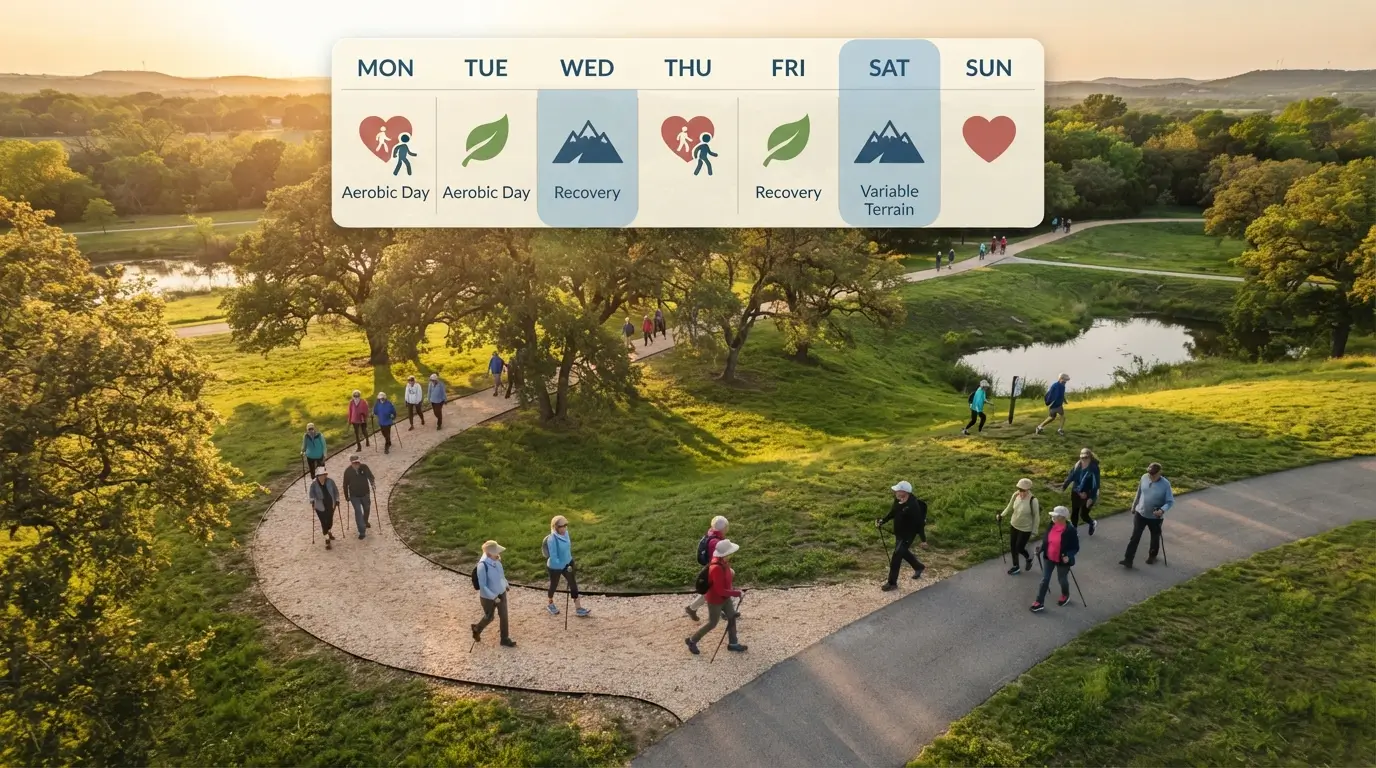
This is a weekly programme that is balanced between aerobic training, active recovery of joints and variety of terrain.
Weekly Walking Framework
| Day | Focus | Duration and Cadence |
|---|---|---|
| Monday | Base Aerobic | 30 mins @ 100 SPM |
| Tuesday | Split Recovery | 15 mins AM / 15 mins PM |
| Wednesday | Steady Tempo | 35 mins at 110 SPM |
| Thursday | Joint Recovery | 20 mins flat surface |
| Friday | Base Aerobic | 30 mins, 100 SPM |
| Saturday | Variable Terrain | 40 mins park path |
| Sunday | Joint Rest | Light stretching only |
Daily Session Details
Monday: Base Aerobic
Stroll 30 minutes at a normal speed. Breathe deeply and slowly. You should be able to say full sentences, but shouldn’t be able to sing.
Tuesday: Split Recovery
Split up the amount of water you want to drink into two shorter walks throughout the day. The first walk should be one hour after breakfast. Repeat the second walk 20 minutes after dinner to help cleanse blood sugar.
Wednesday: Steady Tempo
Warm up for 5 minutes. For 25 minutes walk at higher pace, steps around 110 to 115 steps per minute. Allow 5 minutes to cool.
Thursday: Joint Recovery
Do not take any steps on this walk. Select an all-weather high school track or an asphalt park path that is smooth. Take a slow stroll to help remove metabolic waste from the calves and thighs.
Friday: Base Aerobic
Do the 30-minute walk that was done on Monday again. Make sure that your posture is correct: your eyes should be level and not be rolling forward.
Saturday: Variable Terrain
Walk on packed dirt, grass or light gravel for 40 minutes. Walking on natural surfaces exercises ankle stabilizers and activates your balance reflexes.
Sunday: Joint Rest
Restrict or eliminate structured walking. Take 10 minutes to perform some light stretches of the calf, hamstrings and hips.
Speed, Steps, and Zone 2 Heart Rate Targets
The HR zones are based on the client’s age.
For many seniors, overdoing it represents zone 3, where fatigue sets in in connective tissue. Some walk too slowly to cause cardiovascular changes.
Also Read: Low Cost Mobility Routine for Lunch Breaks 2026
To build an aerobic base without causing burnout, aim for Zone 2. In Zone 2, your body uses fat as fuel by engaging in mitochondrial respiration without elevating systemic inflammation.
[Zone 1: Stroll] ──────> Under 60% HR  ──> Low training stimulus
[Zone 2: Brisk Walk] ──> 60% to 70% HR ──> Aerobic base, fat use, low joint wear
[Zone 3+: Hard Walk]  ──> Over 70% HR   ──> High joint impact, rapid fatigue
Calculating Your Zone 2 Heart Rate
In older people the standard formula (220 minus age) is a bit too conservative in calculating max heart rate. Instead use the Tanaka formula:
Max Heart Rate = 208 − (0.7 × Age)
If you’re a walker over the age of 67:
208 − (0.7 × 67) = 161 beats per minute (BPM)
Zone 2 Target (60% to 70%): 97 to 113 BPM
If your heart rate starts to get into this zone, relax your pace or take shorter steps.
Cadence Targets for Older Adults
| Category | Steps Per Minute | Walking Speed |
|---|---|---|
| Recovery Pace | 80 to 95 SPM | 2.0 to 2.4 mph |
| Aerobic Zone 2 | 100 to 115 SPM | 2.5 to 3.2 mph |
| Fast Tempo | 115 to 125 SPM | 3.3 to 3.8 mph |
To minimize the risk of overstriding, one should try to achieve a rate of 100 to 115 steps per minute (SPM). Overstriding occurs when your foot is positioned too far in front of your body’s center of mass. Simple Daily Walking Plan for Active Retirees This is putting the high braking forces directly into your heel and knee joint.
Shorten your stride; do more steps. The exercise provides the same cardiovascular benefits, but without the same patellofemoral shear stress.
Biomechanics for Aging Joints
The fat pad under the heel bone (the calcaneus) becomes thinner as we get older. Simple Daily Walking Plan for Active Retirees Arches become slack and thoracic spine bends forwards. The biomechanics of walking wouldn’t be the same as it was at 25, so don’t walk that way to aggravate your joints.
1. The Midfoot Roll
Cease “digging your heels in”. Land on the back/midfoot flat on the deck. Smoothly roll on the ball of the foot and push off with the big toe.
2. Forward Gaze
Keep chin level to floor. Eyes 15 to 20 ft. ahead, not on the bottom of your shoes. When looking down, bend the cervical spine forwards, the upper body comes out of alignment and the lower back is stretched.
3. Core Engagement
Slightly tighten the transverse abs (transversus abdominis) as if ready to take a hit. This will keep your pelvis from rocking and your sacroiliac joints from twisting on uneven surfaces.
Essential Gear and Supportive Tools
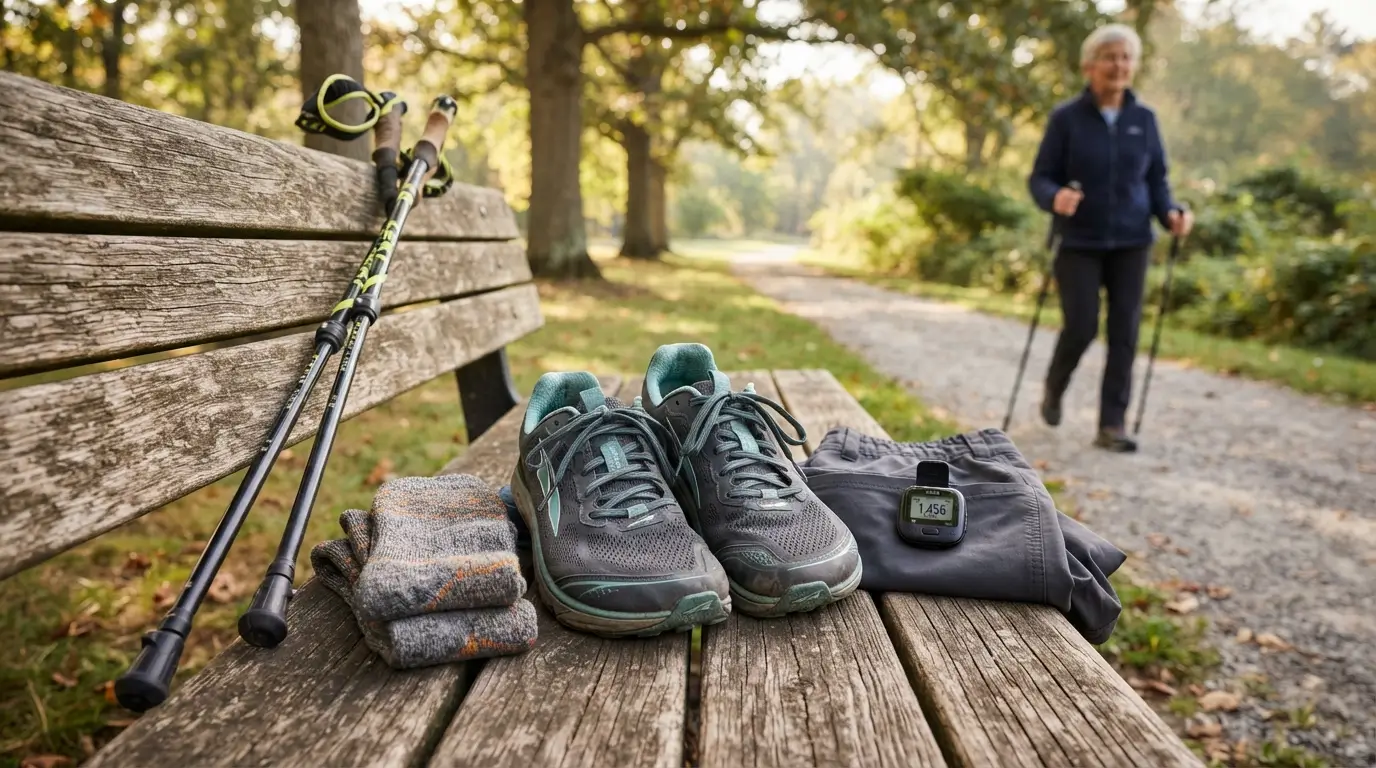
You don’t need a million dollars worth of equipment, but you will definitely get blisters, shin splints and tendonitis if you save money on your shoes and socks.
Gear Recommendations
| Equipment | Recommended Choice |
|---|---|
| Walking Shoes | Wide toe box, 6 to 10mm drop |
| Socks | Merino wool or polyester |
| Walking Poles | Nordic poles with rubber tips |
| Pedometer | Basic digital clip or tracker |
Walking Shoes
Shoes should have a wide toe box which will allow your toes to spread comfortably. Simple Daily Walking Plan for Active Retirees Do not wear shoes with no drop or minimal drop unless you have practiced in your shoes for years. Retirees should desire a moderate amount of heel-to-toe drop (6 to 10 millimeters) that will relieve strain on the Achilles tendon.
The best choices are Brooks Ghost, New Balance 880 or Hoka Clifton. Simple Daily Walking Plan for Active Retirees Expect to pay $130 to $160. Change every 400 miles. The midsole foam is destroyed well before the tread on the rubber wears down.
Nordic Walking Poles
For people who have knee or hip osteoarthritis, purchase a pair of Nordic walking poles (e.g., Leki or Exerstrider) for $40 to $90. Simple Daily Walking Plan for Active Retirees Nordic poles go backwards at an angle to push you forward instead of holding them out in front like trekking poles.
Poles engage the upper back muscles, triceps and core. They reduce up to 20% of the impact forces on the knees and increase calorie burn by 18% at the same speed of walking.
Adapting to Climate and Local Surfaces
The weather makes walking consistency a hard task to accomplish unless you have a plan B.
High-Heat and Sunbelt Climates
Sweat glands don’t work as well when they’re older, and certain types of blood pressure medication may diminish your thirst drive.
- Walk before 8:00 AM.
- Take 8 ounces of water, with a pinch of salt or electrolytes, 30 minutes before going out.
- If the heat index gets into the 85’s (29’s Celsius) move indoors.
Cold Latitudes and Winter Freezes
If packed snow is present, slip a pair of Yaktrax or comparable traction cleats ($20 to $30) over your shoe.
Avoid driving on black ice. A fall during the winter months resulting in a broken hip can drastically change a person’s life.
If there are paths that are iced, use an indoor shopping mall or municipal recreation center.
Surface Choices
Concrete sidewalks are cold and hard. Simple Daily Walking Plan for Active Retirees The asphalt road is a little softer and slopes toward the curb for draining. When you walk along a cambered road, you’ll end up tilting your pelvis, which will drop one hip and rub your IT band.
If possible, use crushed limestone rail-trails, dirt park paths or rubberized community tracks.
Low-Impact Alternatives for Flare-Up Days
Osteoarthritis symptoms strike out of nowhere. If you have a sudden onset of pain in a particular area, such as the knee, hip or ankle, don’t continue. Simple Daily Walking Plan for Active Retirees When you push through joint pain, it alters your stride, putting strain on the other side of your body.
Also Read: Beginner Friendly Gentle Cardio for Bad Knees 2026
Follow these no-impact alternatives to help maintain your daily routine:
1. Shallow Water Walking
Cross the shallow end of heated community pool. Simple Daily Walking Plan for Active Retirees Water resistance exercises build up increased pressure on your hips and quadriceps, and water at chest height removes 75 to 80% of your weight from your lower joints.
2. The Recumbent Stepper
A closed-chain stepping pattern is offered by machines such as the NuStep (e.g., physical therapy clinics and senior living centers). They reduce shear stress to your knees and also provide a good Zone 2 cardio workout.
Community and Group Walking Programs
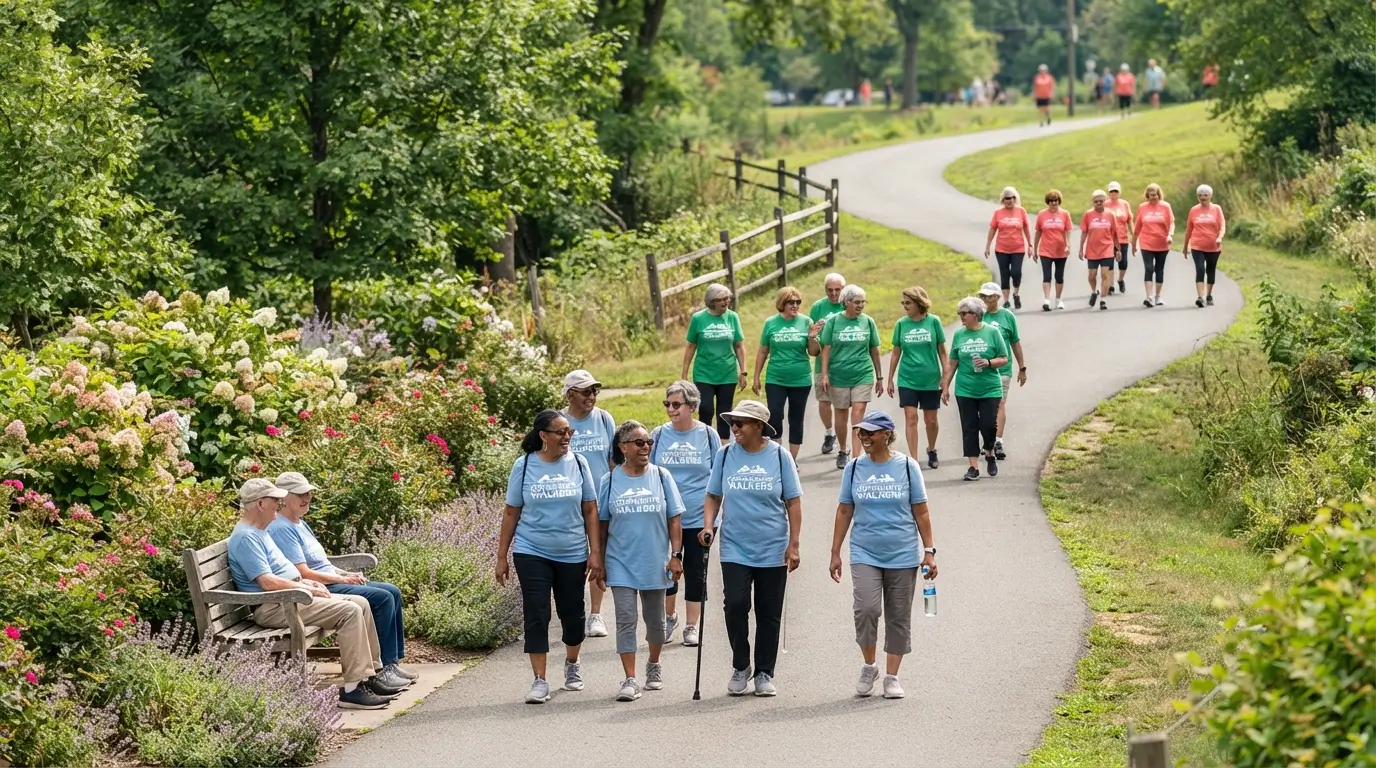
When planning wellness program for a 55+ population or initiating a community neighborhood walking group, do not expect all walkers to be alike. Simple Daily Walking Plan for Active Retirees Having someone who is 82 years old with spinal stenosis in the same walking group as a 62 year old marathon runner and walker results in dropouts and injuries.
[Community Walking Group]
  ├── Group A (The Strollers) ──> 80 to 90 SPM  ──> Flat, smooth loops (15–20 mins)
  ├── Group B (The Cruisers)  ──> 95 to 105 SPM ──> Paved trails (30 mins)
  └── Group C (The Pacers)    ──> 110+ SPM      ──> Varied terrain & hills (40 mins)
Group A (The Strollers): Level surfaces, near benches and water stations. Limit sessions to 15 to 20 minutes, 80 to 90 SPM.
Group B (The Cruisers): 30 minutes of continuous exercise at a pace of 95 to 105 SPM on paved greenways.
Group C (The Pacers): 40 minutes at 110 plus SPM with some gentle hill climbs and grass trails.
Clustering your groups together ensures that all are walking in their comfortable aerobic zone and there is no pressure to match the pace of faster walkers.
Critical Warning Signs to Stop Walking
It’s okay to experience discomfort in your muscles as you begin a new routine. Joint inflammation and cardiac distress are not. Cessation of walking and contact a physician for:
- A tight, heavy, or squeezing feeling in the chest, throat or jaw.
- Rapid dizziness, nausea or cold sweats.
- The sensation of a fast or irregular heartbeat.
- Acute, severe joint pain that affects your walking.
- Rapid, hot enlargement of a calf, ankle or knee muscle.
Frequently Asked Questions
How Many Minutes Should a 70-Year-Old Walk Each Day?
A 70 year old should exercise 30 to 45 minutes a day, 5 days a week. If walking for a whole hour is causing pain to the knee or hip, then do two 15-minute sessions. This can be used for the same cardiovascular benefits, but at a reduced risk of joint stress.
Is Walking 5,000 Steps Enough for Older Adults?
Yes. Research that examines step volume in the elderly reveals that this pushes longevity benefits to begin at 4,500 to 6,000 steps per day. Many retirees get more than their heart deserves in efforts to reach 10,000 steps, without the additional benefit of a good cardiovascular workout.
Can Daily Walking Slow Down Hip and Knee Arthritis?
Yes. Synovial fluid is circulated in the joint capsule during walking, nourishing the cartilage. It’s also great for toning the quadriceps, hamstrings and glutes. Powerful muscles take the impact, allowing your joint surfaces to endure the impact with less stress.
What Is the Ideal Walking Cadence for Someone Over 65?
Moderate aerobic activity is best done at a rate of 100 to 115 steps per minute. This turnover rate allows you to go fast enough to keep your joints in good condition, but not so fast that they are overused.
Should Retirees Walk Before or After Breakfast?
A morning walk of 15 to 20 minutes is beneficial to metabolic health. Walking after a meal increases the uptake of glucose by the muscle cells, which helps to avoid high blood sugar levels in the morning.
Can I Walk Every Day Without Taking Rest Days?
If you’re walking at a low level, it’s possible to walk every day. But try to plan for one or two easy (under 20 minutes) recovery walks per week. This allows your tendons and cartilage to rest and heal.
How Do I Start a Walking Group in My Retirement Community?
Assign to groups based on functional capacity not age. Use the 30-Second Chair Stand test to screen participants, create routes with benches and shade every 1/4 mile, and provide varying pace levels to ensure that no one walks too fast.
Action Plan to Start Tomorrow
Print off the 7 day schedule and stick it on your fridge. Don’t stress out about speed, distance or complicated metrics on your first ride.
Wear comfortable shoes, leave the door and start walking for 15 minutes at a comfortable pace so that you can talk while you are walking. Check on your feet and knees the following morning. If the joints are quiet, a second 15 minute walk can be added later in the day.





2 Comments
[…] Also Read: Simple Daily Walking Plan for Active Retirees 2026 […]
[…] Also Read: Simple Daily Walking Plan for Active Retirees 2026 […]